


When Instagram acts against an account, it usually tells you in one line. “Your account has been disabled.” “We restrict certain activity to protect our community.” A note in Account Status saying the profile can't be recommended. Sometimes there is no notice at all, only a password that stopped working.
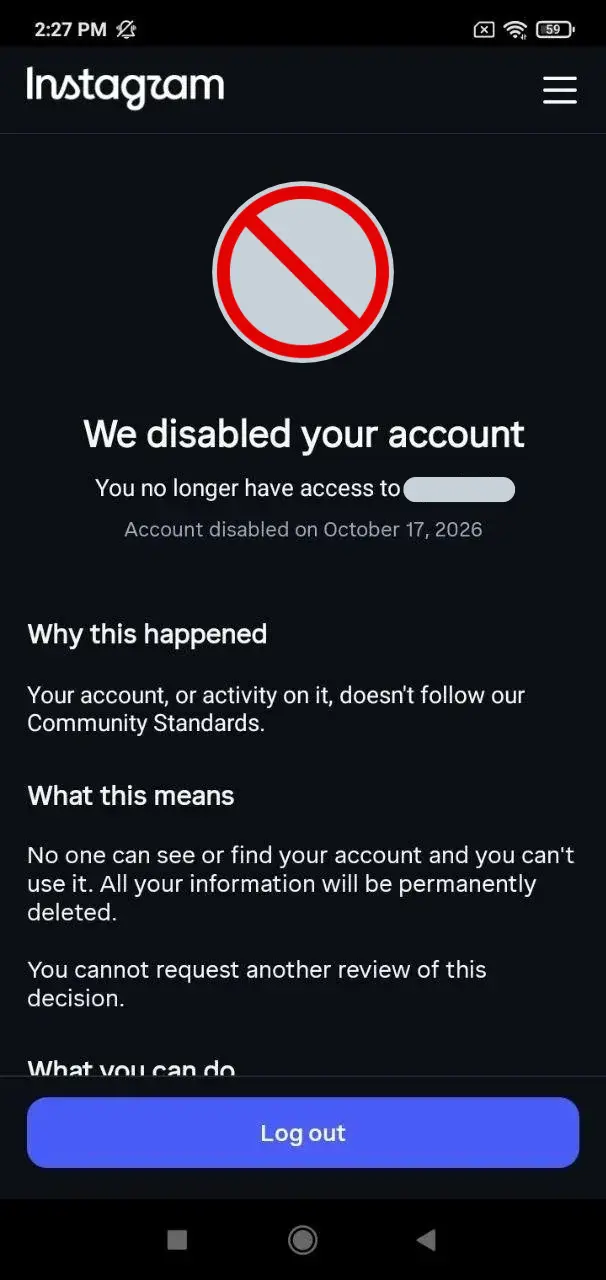
For a creator who earns from an account, that line is the whole briefing. It rarely says how long the decision lasts, whether a second review exists, or what evidence would help. Most people search for an answer and find blog posts that disagree with each other, “30-day” rules nobody can source, and paid recovery services.
We've been on the receiving end. One of our collab pages, @cybeauty.influencers, had its Collab features restricted in March 2026, and our other page, @cybeauty.collabs, has received Instagram warnings. Cybeauty One indexes AI and virtual influencers, and most of our readers are creators who run exactly the kind of account Instagram's rules are changing around. So we built two tools and a guide for the moment before trouble and the moment after it. This article explains the problem they address, what they do, and where their limits are.
Eight problems that look alike and aren't
The notices sound similar, but they lead to different places. A disabled account is appealed from the login screen. A profile that can't be recommended is reviewed in Account Status, and its account still works: followers see its posts. A blocked Collab feature can be disputed through the “Tell us” link on the message or in Account Status. A hacked account isn't an appeal at all; it goes through Instagram's recovery steps, starting with the security email that reported the change.
We sorted what creators run into into eight cases: disabled, suspended with a countdown, not recommended under the AI-generated profile label, Collab and other feature limits, a flagged bio or link, mass reporting, a ban because of a linked account, and a hacked account. Each has its own route, and using the wrong one costs time you may not have.
Deadlines are the part most guides get wrong. In the Help Center pages we checked, Meta publishes exactly one: an Oversight Board appeal must be filed within 15 days, and only after Meta has reviewed the decision twice. It isn't available for disabled accounts, because the Board's rules require an account you can still log in to. The 180-day window that creators talk about is real for some people. The journalist M.G. Siegler saw it on his own suspension notice in 2024, and other creators report 30 days instead. But Meta's Help Center doesn't publish either number. The honest advice is to use the date on your own screen and not wait for it.
The first request also matters more than people expect. When Siegler appealed his suspension, the notice changed the next morning to say his account was disabled and that he could not request another review. Users have reported the same message in 2026. A rushed appeal sent in the first ten minutes can be the only one you get.
Why AI influencer accounts have it harder
On August 31, 2026 Instagram renamed its “AI creator” label to “AI-generated profile” and said it would limit the reach of profiles that feature an AI-generated person without it. The fix here is not an appeal. It is turning the label on, from Edit profile in the app (the setting isn't on desktop). Instagram's Help Center says the label itself “will neither help nor hurt” an account's reach. An appeal is only for a real person who was flagged by mistake, and Instagram has said its detection may not always be accurate. We covered the label in detail in our guide to the AI-generated profile label.
Identity checks are the second problem. When Instagram asks for a video selfie, Meta compares it with the profile pictures on the account. An operator's real face will not match a synthetic persona, so that route may simply fail. For accounts that don't show photos of the owner, Instagram's hacked-account help asks instead for the email or phone number used to sign up and the type of device used at signup. Many operators never wrote those down. A generated face or a persona “ID” is not an alternative; it is deceptive evidence, and it can turn a reversible decision into a permanent one.
Running several personas adds a third risk. Accounts linked in the same Accounts Center can go down together, and nothing Meta publishes says whether one successful appeal brings the others back. Each disabled account needs its own request. The instinct to open a fresh account, or to hide the link with extra SIM cards or VPNs, is the conduct Meta's policy treats as evading enforcement.
Then there is reporting. Instagram's Help Center says the number of times something is reported doesn't decide whether it's removed, and Meta's policy bans using fake accounts to misuse reporting. That doesn't make campaigns harmless. In a 2021 takedown Meta described a network that also set up copies of its targets' accounts and reported the real ones as impersonators. A persona is an easy target for that kind of report, because the “real person” in the photos doesn't exist. A visible AI label and a public link to whoever runs the persona give a reviewer something to check. Our guide to mass reporting goes further.
Why the work has to start before anything happens
Most of what helps in an appeal is evidence, and most evidence can only be collected while the account still works. Once an account is disabled it isn't visible to others, its inbox goes with it, and Account Status may not open. Many of the public comments the Oversight Board received on account bans in 2026 said people couldn't download their content after a ban.
A few things are worth doing now, while nothing is wrong. Request a copy of your data from Accounts Center; Instagram says the link can take up to 30 days to arrive, so it isn't something to start in a crisis. Write down, for every persona, the signup email, phone number, signup date, the device you created it on and the two-factor method. Turn on the AI-generated profile label if the account features an AI-generated person, and screenshot the setting with the date. Move brand contracts and contacts out of Instagram DMs. Use an authentication app for two-factor sign-in rather than text messages.
None of this takes long, and none of it can be done after the fact. A creator who has it ready writes a short, factual appeal with proof attached. A creator who doesn't is left guessing which email they used three years ago.
What we built
The Appeal Builder opens with one question: is your account in trouble right now?
If the answer is no, it sends you to the Risk Check. That's twelve questions on labels, disclosure, likeness, records, backups, security and paid posts, and it takes about a minute. You get a score out of 100 and your top three risks straight away. If you leave a first name and email, you can download a full 48-hour action plan.
If the answer is yes, the diagnosis asks what is on your screen and a few follow-up questions, then sorts you into one of the eight cases. The result for each case gives:
- Meta's route, step by step, in the order Meta documents it
- the deadline, or a plain statement that Meta publishes none
- what to screenshot and collect before you submit anything
- what not to do
- extra notes when the account is an AI influencer
- whether the Oversight Board is open to you
- links to the Meta pages the route comes from
The diagnosis costs nothing, needs no login and never asks for your Instagram password. Your answers stay in your browser.
The Instagram Survival & Appeal Pack, at $9, is for preparing while the account is still healthy. It is a PDF guide in 18 sections with an Evidence Log spreadsheet. The guide covers a decision tree for which problem you have, the first 48 hours, a section for each problem, a five-step method for writing your own review request, a security routine, a continuity plan with messages to send followers and brand partners, and printable checklists. Every claim in it is labeled as Meta's own rule, our practice, or a single reported case, so you can tell which is which. It is a digital download and a final sale.
The full kit, at $29 for one case or $49 for unlimited cases and accounts, is in pre-launch. It will write the appeal from your answers and the reason Instagram gave, with a separate appeal for each linked account, an evidence log, a 14-day recovery checklist and records for each persona. Until it opens, the Appeal Builder shows a sample of its output for an invented account, and you can join the waitlist.
What the tools won't do
No one outside Meta can promise an account back, and we don't. Meta makes every decision and publishes no review times. The Appeal Builder doesn't contact Meta, doesn't log in to your account and doesn't submit anything for you: you send the appeal yourself, inside Instagram.
Some requests the tools refuse. They won't help hide that a profile shows an AI-generated person, get around a ban, or verify an identity with a face that isn't the owner's. They won't write anything for an influencer built on a real person's likeness without that person's consent. Cybeauty One is not affiliated with Meta or Instagram.
The results for disabled, suspended, linked and hacked accounts all carry one warning, because the timing makes it matter. People who have just lost an account are the main target of recovery scams. The Better Business Bureau has warned about “recovery” companies that charge rising fees and never get the account back, and some that go on to ask for bank details. Instagram's own appeal and recovery routes cost nothing, and Instagram doesn't ask for login codes or contact you about security by direct message. Anyone who offers to restore an account for a fee should be treated as a scam.
How we checked the routes
The routes in the Appeal Builder were checked against Meta's own pages on November 15, 2026: the Instagram Help Center, the Meta Transparency Center, the Instagram Creators blog and the Oversight Board's appeal pages. The tool shows that date, and we re-check the Meta links before each update.
While checking, we sorted every claim into three kinds: what Meta documents, what the press has reported, and what circulates among creators without a source. The third group turned out to be large. Fixed “30-day collab jail” lengths, daily caps on Collab invites, “log in from your original device” fixes and success-rate figures for appeals had no Meta source we could find. Where Meta publishes nothing, the Appeal Builder says so instead of filling the gap, and the pack labels each claim the same way. The result is less certain than many guides, and that is deliberate: a confident wrong deadline is worse than an honest “Meta doesn't say”.
Where to start
If something has already happened, don't tap anything on the notice yet. Screenshot it first, including any date, then run the diagnosis in the Appeal Builder and follow the route it gives you before you write a word of your appeal. If you were hacked, start with the security email Instagram sent, not with an appeal.
If nothing has happened, run the Risk Check, fix the first of your top three risks this week, and request your data export today so it's ready if you ever need it. The pack covers the rest of the preparation at your own pace.
A well-written appeal helps, but it can only use what you have. Knowing the signup email, having the label on and being able to show what the account posts on the day the notice arrives is what gives it something to say.
Sources
- Instagram Help Center, About disabled Instagram accounts
- Instagram Help Center, Check your Account Status
- Instagram Help Center, Recommendation eligibility
- Instagram Help Center, About AI-generated profiles on Instagram
- Instagram for Creators, Bringing More Transparency to AI-Generated Profiles on Instagram (August 31, 2026)
- Instagram Help Center, Create collaborative posts on Instagram
- Instagram Help Center, How Instagram decides what to remove
- Instagram Help Center, If you think your Instagram account has been hacked
- Instagram Help Center, Appeal to the Oversight Board
- Instagram Help Center, Export a copy of your information
- Meta Transparency Center, Inauthentic Behavior policy
- Meta, Adversarial Threat Report (December 2021)
- Meta, Testing new ways to combat scams and restore compromised accounts (October 2024)
- Oversight Board, Frequently asked questions
- Oversight Board, decision on Meta's approach to disabling accounts (June 2026)
- Engadget, Even Meta's Oversight Board thinks its rules for banning accounts are baffling (June 2026)
- TechCrunch, Meta's Oversight Board says account bans lack due process and transparency (June 4, 2026)
- Spyglass, M.G. Siegler on being wrongly banned by Instagram (2024)
- News4JAX, Why the BBB says you should never pay to recover your social media account (November 16, 2023)