



Most of what you can read about making money with an AI influencer is written by companies that sell AI influencer tools. The income screenshots are real enough, but they show the best month of the best account, and they leave out the cost of making the content, the accounts that got banned and the months that earned nothing.
This guide tries to give the straight version. It covers where the money actually comes from, what the public earnings figures do and don’t prove, how many paying fans a monthly income really takes, what it costs to run a character, and why most AI influencers never earn anything. Where we use our own experience, it comes from an AI influencer we have run since 2023, and we say so.
Can an AI influencer make money?
Yes, but far less often and far less easily than the ads suggest. A few AI influencers earn thousands of dollars a month, and the ones that do almost always earn it in one of two ways: subscriptions and paid messages on a fan platform such as Fanvue, or brand deals once the account has a large, engaged audience. Followers alone pay nothing. The money comes from the small share of followers who buy something, and getting them takes months of steady posting, an account that survives the platforms’ rules and a character people care about.
The AI influencer we run has signed several brand partnerships since 2023, one of them with Uncensored.com; the others are covered by non-disclosure agreements. Each came only after months of building an audience, and none of them was a salary.
How AI influencers make money
There are seven ways AI influencers earn money, and they suit very different accounts. Most earning accounts rely on one or two of them.
1. Subscriptions and paid messages on fan platforms
This is where most AI influencer money is made. Fans pay a monthly subscription to see exclusive content, then pay again for locked messages, custom requests and bundles. Fanvue is the main platform that accepts fully AI-generated creators. OnlyFans and Fansly allow AI content only when it depicts a verified human creator, so a character with no real person behind it can’t use them.
Fanvue says it has more than 250,000 creators and 17 million monthly active users, and that it reached a $200 million annualised revenue run rate in July 2026. Creators keep 80% of what fans pay, with refunds and chargebacks deducted. Fanvue doesn’t publish how much of its revenue comes from AI characters; the analyst firm Sacra estimated about 15% in mid-2025, and Fortune reported the same share for November 2023. Fanvue also requires AI content to carry a clear disclosure, so fans know they are paying for a character.
Messages can earn more than subscriptions, because a subscription is a one-off monthly price while messages and custom requests can be sold again and again to the same fan. That is also the most time-consuming part of the business. Our guide to selling custom requests on Fanvue covers how to price them.
2. Brand deals and sponsored posts
Brands pay accounts to feature their products, as they do with human influencers. Aitana López, created by the Barcelona agency The Clueless, is the best-known example: in November 2023 her creators said she earned an average of €3,000 a month and once took in €10,000, mostly from advertising, when she had about 122,000 Instagram followers. Those are the agency’s own figures. The AI influencer we run has signed several brand partnerships, including one with Uncensored.com; we can’t share the terms or name the others because of non-disclosure agreements, which are standard in these deals.
Brand demand for AI influencers is weaker than it was. Collabstr, an influencer marketplace, said in September 2025 that brands’ openness to letting AI influencers apply for their campaigns had dropped by about 30% between late 2024 and early 2025. Brand deals are realistic for accounts with a large, clearly non-adult audience in a niche such as fashion, fitness or tech, and rarely for anyone else.
3. Collaborations with other creators
AI influencers also partner with each other: shared posts, shout-outs and joint promotions that send each account’s audience to the other. The AI influencer we run had a short brand partnership with another AI influencer’s team in early 2024. Deals like this are usually paid in audience rather than cash, but they can be the fastest way for a new account to be seen.
4. Affiliate links and shop commissions
An account can earn a commission on products it recommends through affiliate links, a storefront or TikTok Shop. The amounts are small per sale, and they only add up on accounts whose audience buys things the character plausibly uses. Check each programme’s rules first: some require a real, verified person behind the account.
5. Making AI ads for brands
Some creators use their character, or the skills they learned building it, to make AI user-generated-content ads for brands: short videos of a person holding or talking about a product. This is a service business rather than influencer income, and it pays per video rather than per follower. Tools such as Higgsfield’s Marketing Studio and WaveSpeed’s AI Influencer Studio are built for it.
6. Licensing the character
A character that becomes well known can be licensed for merchandise, games and media. It is rare. John Pork, the pig-headed virtual character created in 2018, reached a licensed Roblox appearance and a stand at Brand Licensing Europe in 2026, eight years in. His story shows how long that road is.
7. Selling courses and tools to other creators
Plenty of AI influencer accounts make money by teaching others to build AI influencers. It only works if your audience is made of would-be creators. We tried it: we published a guide for creators and promoted it to our character’s followers, and it sold nothing, because those followers were fans, not creators. If your audience came for the character, sell them the character.
How much do AI influencers make?
Nobody publishes reliable averages. No platform has released how many AI creators it has or what they typically earn, and the figures in the press are almost all individual claims made by the creators or their agencies. These are the best documented:
| Account | Reported earnings | Source of the figure |
|---|---|---|
| Aitana López | €3,000 a month on average, €10,000 in one month (2023) | Her agency, The Clueless, via Euronews and Fortune |
| Emily Pellegrini | $23,000 in January 2024, up from $6,000 in October 2023 | Her anonymous creator, via Fortune |
| Hailey Lopez | $2,500 to $4,000 a month from 150 subscribers (2024) | Her anonymous creator, via Fortune |
Read these as what is possible, not what is typical. They are among the most successful AI characters, chosen by the press because they earned a lot, and the hours behind them are rarely mentioned: Fortune reported that Emily Pellegrini’s creator worked 14- to 16-hour days to build the account and then about eight hours a day talking to fans.
The wider creator economy gives a sense of scale. Goldman Sachs estimates there are about 50 million creators worldwide and that only about 4% earn more than $100,000 a year. There is no reason to think AI creators beat those odds.
How many followers do you need to make money?
Followers don’t pay; paying fans do. The useful question is how many paying fans a target income takes, and that is simple arithmetic. On Fanvue you keep 80% of what fans pay, so $2,000 a month after fees takes $2,500 of fan spending.
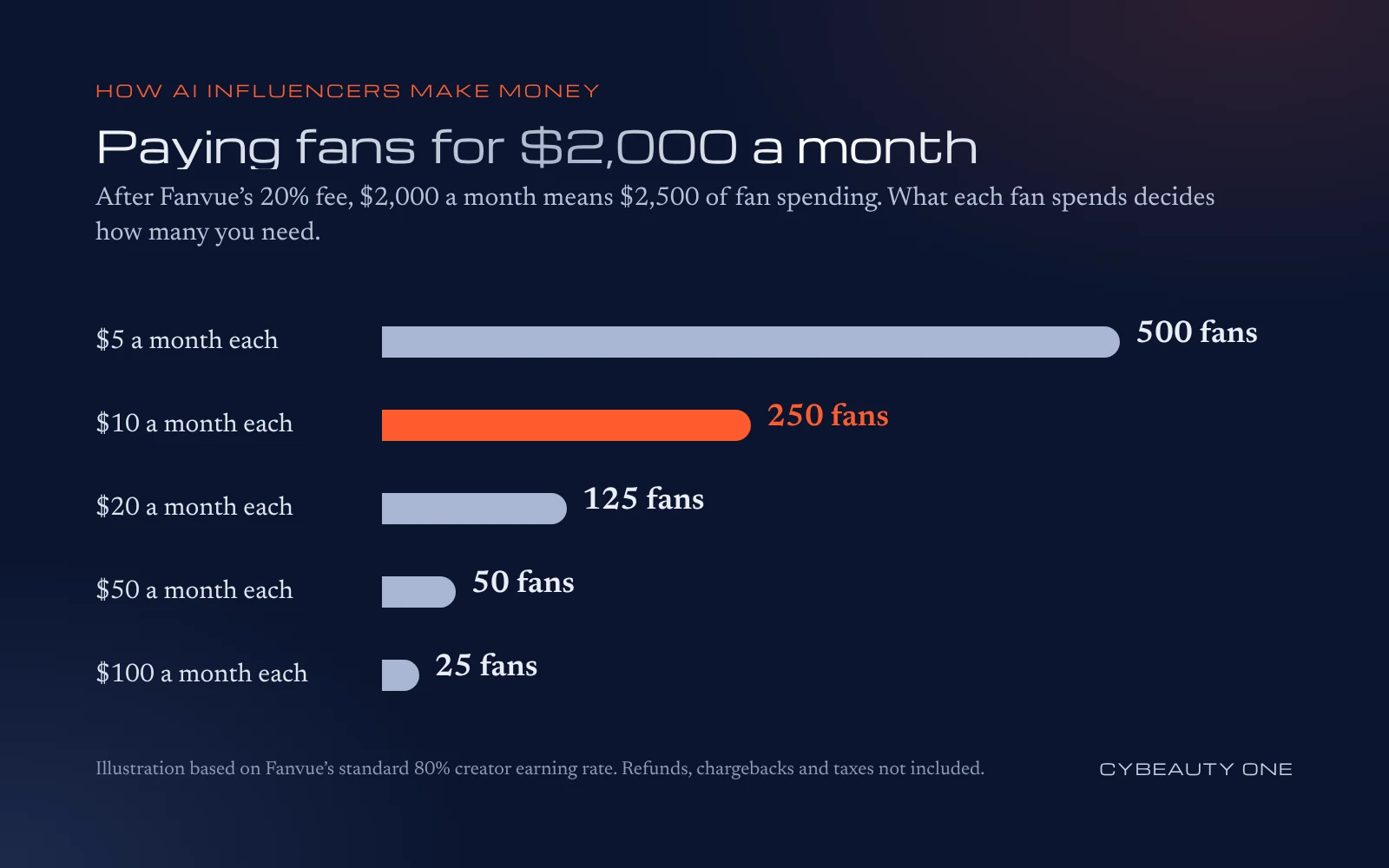
If your fans spend $10 a month on average, you need 250 of them. If a smaller group spends $50 each on messages and customs, you need 50. That is why message sales matter more than subscription price, and why accounts with modest followings can out-earn much bigger ones.
How many followers it takes to find those fans depends on how many people click through and buy, and nobody publishes reliable conversion rates for AI accounts. Track your own: followers, link clicks, new subscribers and spending per fan each month. After two or three months you will know your numbers better than any benchmark.
What it costs to run an AI influencer
The content itself costs less than most people expect, and failed attempts are the biggest part of it. A month of 60 posted images and 20 short video clips, at three attempts per kept clip, cost between about $57 and $285 when we priced it in November 2026, depending on the video model and where you run it. Our WaveSpeed review and Higgsfield review show that calculation model by model, and the AI content cost calculator works out your own figure.
The larger costs are elsewhere. Editing, posting and talking to fans take hours every day, and many creators pay chatters, editors or an agency a share of revenue to do it. Platform fees take 20% on Fanvue. Chargebacks and refunds come out of your balance. And there is the cost of starting over when an account is lost, which brings us to why most AI influencers fail.
Why most AI influencers never make money
The most common reasons are not creative ones.
The first is reach. Instagram, TikTok and Threads are where AI influencers find fans, and all three limit content and links they consider risky. In October 2026 Instagram flagged the links to our own character’s website under its Recommendation Guidelines, a website that had never been flagged before, and restricted the account again when we re-added the link, until we removed it. Many creators now send followers through an intermediate step, such as a Telegram channel or a link page, before the fan platform. Our Risk Checker scores how exposed an account is, and the guide to Instagram restrictions explains what triggers them.
The second is the rules. Most platforms now require AI content to be labelled, and the rules differ by platform and change often. Missing a label can mean removed posts or a lost account. Our AI disclosure rules tracker lists what Instagram, TikTok, YouTube, Fanvue and others require, and the Appeal Builder helps if an account is restricted anyway.
The third is the audience. An account can grow quickly on attractive images and still earn nothing, because its followers came to look, not to pay, or because they came for something the account doesn’t sell. Our failed guide for creators is an example. Look at who actually follows you before deciding what to sell.
The fourth is time. Characters that earn usually post every day for months before the first meaningful payout, and most creators give up before then. The money also isn’t safe once it arrives: our own sales fell when an Instagram algorithm change cut the traffic that fed them.
Is it legal, and is it allowed on Instagram?
Running an AI influencer is legal in most countries, and Instagram, TikTok and YouTube allow AI-generated accounts as long as AI content is labelled where their rules require it. The legal risks come from what the character does: using a real person’s face or voice without consent, making content that resembles a minor, which every major platform bans, misleading fans or advertisers about what they are buying, and failing to disclose sponsored posts. In the EU, the AI Act adds transparency duties for AI-generated content. We are not lawyers, and if you sign brand deals or employ people, it is worth paying one.
How to make an AI influencer that earns
If you still want to try, this order gives a new account the best chance.
- Decide who will pay and for what before you design the character. A fan subscription business, a brand-friendly lifestyle account and an AI ad service need different characters and different platforms.
- Build a character that is recognisable at thumbnail size and consistent from post to post. Tools such as Higgsfield’s AI Influencer builder and Soul ID or WaveSpeed’s AI Influencer Studio handle the consistency. Our comparison of AI influencer generators covers the alternatives.
- Check the disclosure rules for every platform you will use, and label from the first post.
- Post daily on one or two social platforms for at least three months, and track followers, clicks and sales from the start.
- Open the paid side early, with a low entry price and a clear menu of messages and custom requests, and keep proof of ownership of everything you post, in case it leaks.
- Keep production costs below a fixed share of income. Log your attempts in the cost calculator so you know your cost per usable post.
Frequently asked questions
Are AI influencers profitable?
Some are. A small number earn thousands of dollars a month, mostly from fan subscriptions, paid messages and brand deals, but most never earn enough to cover their running costs and the time they take. No platform publishes average earnings for AI creators.
How much does an AI influencer make a month?
Published examples range from a few hundred dollars to about $23,000 in a single month, and the best-known figures come from the creators themselves. There is no reliable average.
How many followers do I need to make $2,000 a month?
It depends on paying fans, not followers. After Fanvue’s 20% fee, $2,000 a month takes 250 fans spending $10 each, or 50 spending $50. How many followers produce those fans depends on your own conversion rate.
Can an AI influencer be on OnlyFans?
Only as AI content depicting a verified human creator. OnlyFans and Fansly don’t allow fully AI-generated characters without a verified person behind them. Fanvue does, with clear AI disclosure.
Will AI replace influencers?
Not on current evidence. AI influencers are a small share of creators, brand openness to them fell in 2025, and the best-earning human creators sell trust and personality that a character finds harder to build. AI will replace some content work, such as product ads, sooner than it replaces the people fans follow.
Figures in this guide were checked on November 23, 2026. Earnings attributed to named AI influencers are their creators’ claims as reported in the press, not verified income.
Sources
- Business Wire, Fanvue passes $100M run rate and raises $22M Series A (January 12, 2026)
- Fanvue, Creator Earnings and Payouts policy (updated April 22, 2026)
- Fanvue, Community Guidelines (updated October 12, 2026)
- Sacra, Fanvue at $65M ARR (June 3, 2025)
- Fortune, AI influencers’ secretive creators earn thousands of dollars (February 21, 2024)
- Fortune, Spanish agency’s AI model earns up to $11,000 a month (November 23, 2023)
- Euronews, Meet the first Spanish AI model earning up to €10,000 a month
- Net Influencer, Collabstr data on brand openness to AI influencers (September 26, 2025)
- Goldman Sachs, The creator economy could approach half a trillion dollars by 2027
- Cybeauty One, AI disclosure rules by platform
- Cybeauty One, AI model prices (checked November 21, 2026)